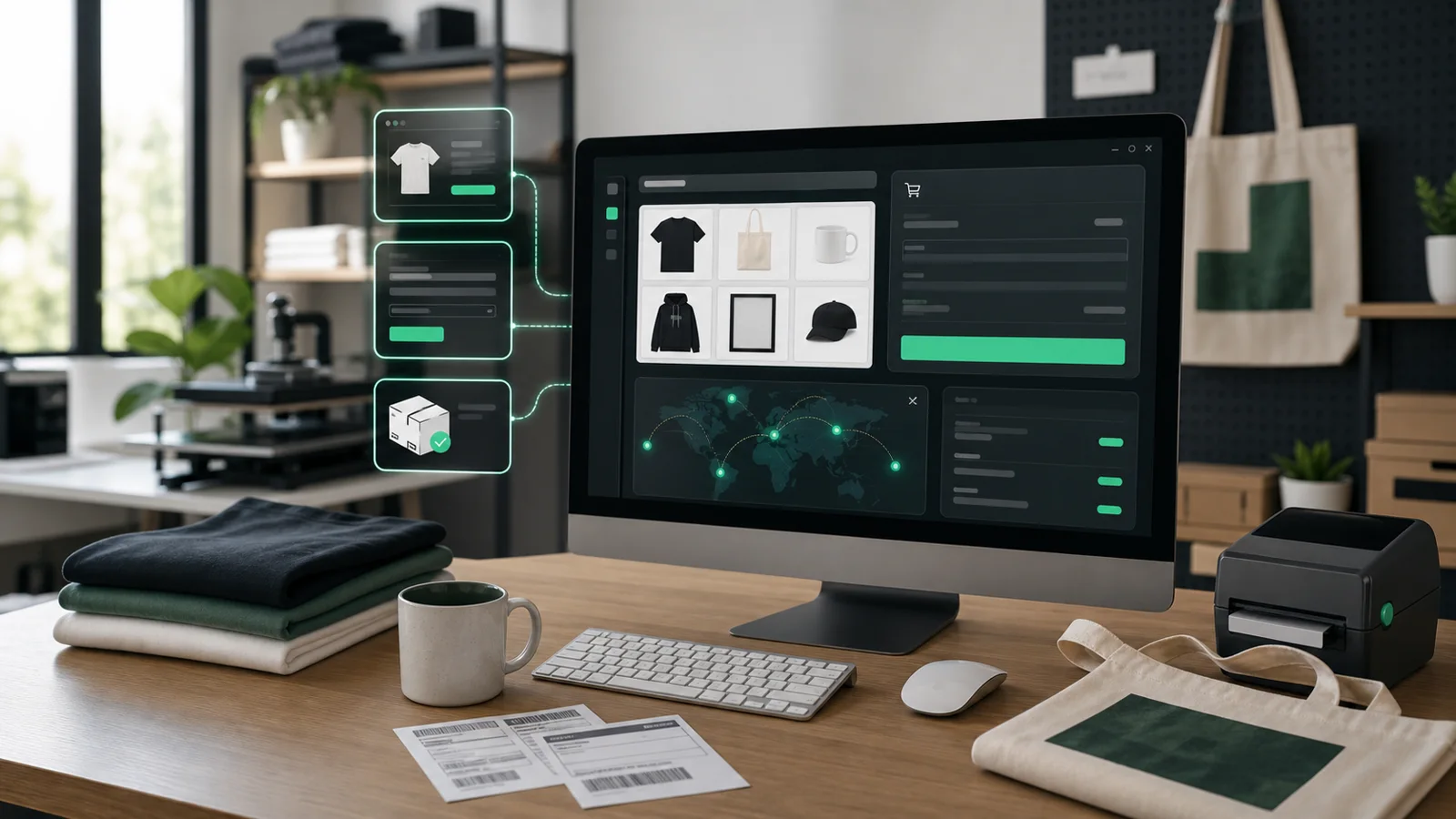
Yes, you can run print on demand without Shopify. Shopify is a popular storefront and app ecosystem, but it is not required to sell POD products. You can use a marketplace like Etsy, a provider-hosted storefront from Printify or Printful, a site builder, WooCommerce, or a custom store connected directly to your payment and fulfillment accounts.
The better question is not whether you can sell print on demand without Shopify. The answer is already yes. The better question is which parts of the business you want to own: the domain, checkout, customer data, product pages, fulfillment workflow, analytics, and long-term brand equity. A Shopify-free setup can be faster, cheaper, more flexible, or more owned depending on the route you choose.
If the owned-store route is what you are trying to build, podOS by podCARTEL is built for beta sellers who want a POD store on their own domain, payments through their own Stripe account, fulfillment through their own provider accounts, and infrastructure in their own Cloudflare account.
What Shopify Normally Handles in a POD Business
Before replacing Shopify, it helps to name what Shopify usually does for a print-on-demand seller.
Shopify gives you a hosted storefront, product pages, checkout, themes, discount codes, order management, app integrations, and a familiar admin. POD providers such as Printify, Printful, Gelato, and Gooten can connect to ecommerce platforms so orders flow from the store to the fulfillment provider.
But Shopify is still rented infrastructure. You pay an ongoing plan fee, card processing and transaction-related costs depending on your payment setup, and often extra apps for reviews, personalization, bundles, upsells, abandoned checkout, email capture, or POD-specific operations. For many sellers, that is worth it. For others, it becomes a middle layer that never goes away.
Selling print on demand without Shopify means choosing another layer to handle the same jobs: storefront, checkout, payment capture, order routing, fulfillment status, customer support, and analytics.
Your Main Options Without Shopify
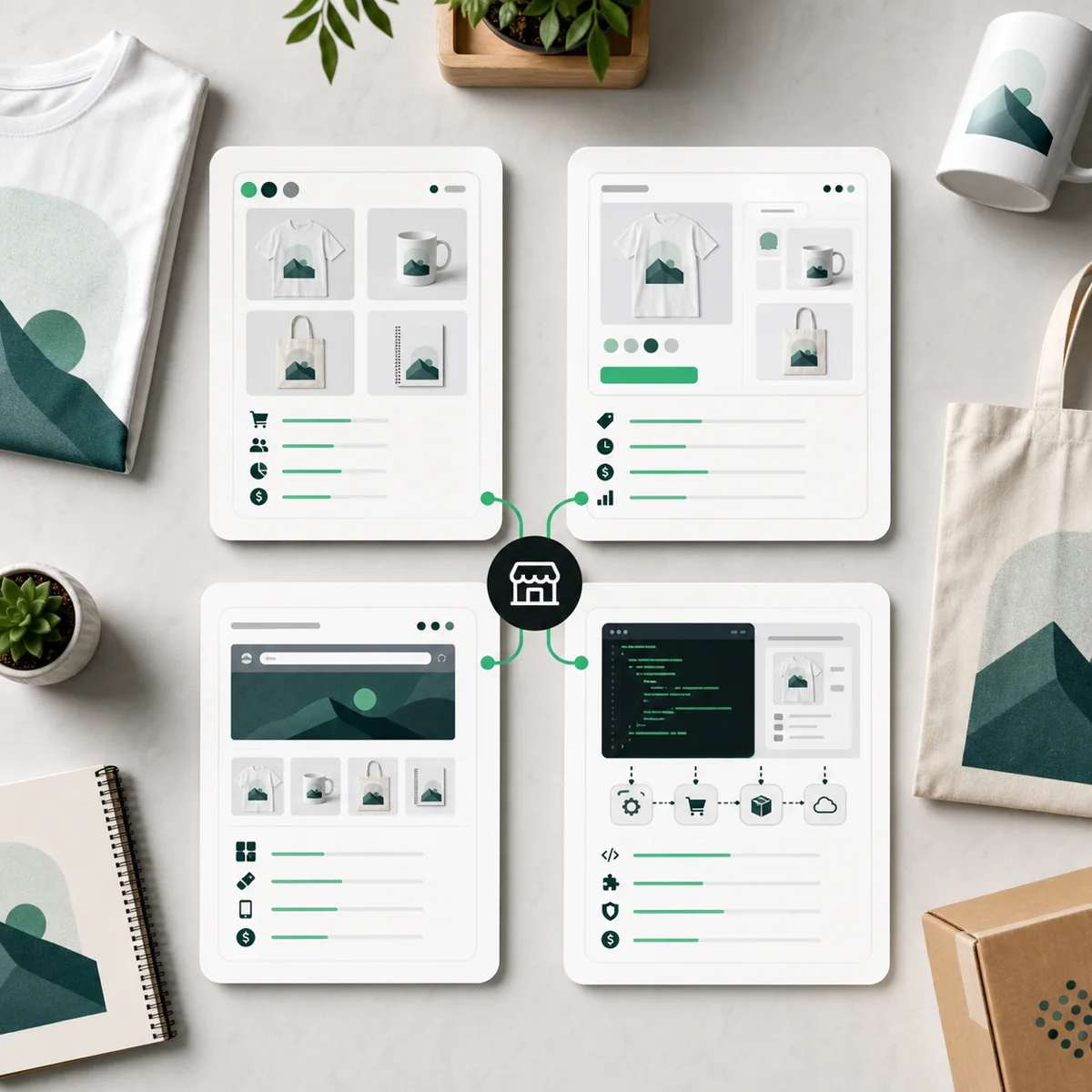
There are five realistic paths for a Shopify-free POD store. The right choice depends on whether you care most about validation speed, marketplace demand, brand control, operational flexibility, or long-term ownership.
| Route | Examples | Cost model | Ownership level | Best fit |
|---|---|---|---|---|
| Marketplace | Etsy, Amazon, TikTok Shop | Listing, transaction, payment, ad, or referral fees depending on marketplace. | Limited. You get discovery, but the platform controls much of the customer experience. | Testing demand and reaching buyers already searching. |
| POD quick store | Printify Pop-Up Store, Printful Quick Stores | Often low or no monthly storefront fee, but provider terms matter. | Limited compared with a full owned store. | Fast validation with minimal setup. |
| Site builder or hosted ecommerce platform | Wix, Squarespace, BigCommerce | Monthly plan plus processing and possible app costs. | More brand control than marketplaces, less ownership than self-controlled infrastructure. | Creators and small brands that want an easier hosted site. |
| WooCommerce | WordPress plus WooCommerce | No WooCommerce platform fee, but hosting, maintenance, themes, extensions, and support cost money. | Stronger control and portability, with more admin responsibility. | Sellers who want open-source flexibility and can maintain it. |
| Custom owned store | Custom/API build, POD-native owned software, podOS early access | Depends on hosting, infrastructure, software, and development model. | Highest potential ownership: domain, data, content, analytics, checkout, and workflow. | Sellers building a durable independent brand and operating system. |
Shopify sits outside this table as the common baseline: it is a mature hosted ecommerce platform with a large app ecosystem. The tradeoff is that you are building on a platform you rent month after month.
Option 1: Sell Through a Marketplace
Marketplaces are the simplest way to sell print-on-demand products without Shopify because they already have buyers. Etsy is the clearest example for many POD sellers: list products, connect a POD provider if supported, and benefit from search behavior that already exists inside the marketplace.
The tradeoff is control. On Etsy, sellers should understand listing fees, transaction fees, payment processing, ad rules, and production partner requirements. If you design an original product and use a print provider to make and ship it, Etsy's rules require production partner disclosure where applicable.
A marketplace can be excellent for validation. If your products start working, the next risk is dependency: your customer relationship, ranking visibility, storefront presentation, and account standing all live inside someone else's system.
Option 2: Use a POD Quick Store
Some POD providers offer lightweight storefronts. These can be a good answer to how to start print on demand without Shopify if your main goal is speed.
Printify Pop-Up Store is a hosted storefront option that can be launched without a separate ecommerce platform. Printify's docs describe a flow where the provider handles payment processing, printing, shipping, and customer support, then transfers seller earnings. It can use a default Printify URL or a custom domain.
Printful also supports ways to sell without Shopify, including manual orders, supported non-Shopify integrations, API workflows, and Quick Stores. The research docs noted that Printful Quick Stores were limited to U.S. merchants and U.S. delivery, and did not support custom domains at the time checked. Because provider-hosted products change, verify current availability before building your launch plan around them.
The main benefit of a POD quick store is that it collapses setup. The main limitation is that you are still inside the provider's storefront and operating model. It is not the same as owning the store, checkout, customer data layer, and fulfillment routing logic.
Option 3: Use a Site Builder or Hosted Ecommerce Platform
Wix, Squarespace, BigCommerce, and similar platforms can work for POD sellers who want something more design-friendly or less app-heavy than Shopify. This route is usually more brandable than a marketplace or provider-hosted storefront, and depending on the platform and provider, you may be able to connect Printify, Printful, Gelato, or other POD services so orders import automatically.
The tradeoff is that a hosted site builder is still a rented platform. You get convenience, managed hosting, templates, and built-in tools, but your checkout, app model, and operational boundaries are defined by the platform. If you later need advanced fulfillment logic, multi-provider routing, or custom diagnostics, you may hit the ceiling.
Option 4: Build With WooCommerce
WooCommerce is the most common open-source path for sellers who want more control without building everything custom. WooCommerce itself has no platform fee, but that does not mean the store is free. You still need hosting, a domain, a theme, payment processing, security, updates, backups, and possibly paid extensions or developer help.
For POD, WooCommerce can be powerful because many providers support WooCommerce paths. Printify, Printful, Gelato, and Gooten all have WooCommerce or API routes in their ecosystem. You can own more of the site structure, content, SEO surface, and data than you would on a marketplace.
The cost is responsibility. WordPress updates, plugin conflicts, speed, checkout reliability, spam, analytics, and security become your problem or your developer's problem.
Option 5: Build a Custom Owned Store
The most controlled version of print on demand without Shopify is an owned store: your domain, checkout, payment processor account, POD provider accounts, data, infrastructure, and order workflow.
In this model, Stripe is relevant because payments can go through the merchant's own Stripe account. That does not mean payments are free. Stripe charges processing fees. The ownership point is a direct payment relationship instead of relying entirely on a marketplace payout or provider-hosted payment flow.
Cloudflare is relevant because infrastructure can run in the seller's own account. That does not mean there are no operating costs. Cloudflare has free and paid developer-platform tiers, limits, and usage-based details. The ownership point is that the storefront infrastructure is attached to the seller's account, not buried inside a generic hosted ecommerce product.
POD providers are relevant through integrations and APIs. Printify and Printful both document API routes. Gelato and Gooten also support integrations or API-based workflows. A custom store can use those provider accounts directly, route products, collect fulfillment statuses, and create diagnostics specific to print-on-demand operations.
That is the path podOS is built for: a buy-once, POD-native owned-store model for independent sellers who do not want to assemble a generic ecommerce platform, a stack of apps, fulfillment scripts, and provider dashboards by hand. The current closed beta is for sellers who want to secure the software license, get into the onboarding queue, and use the white-glove setup offer while it is still available.
When Shopify Still Makes Sense
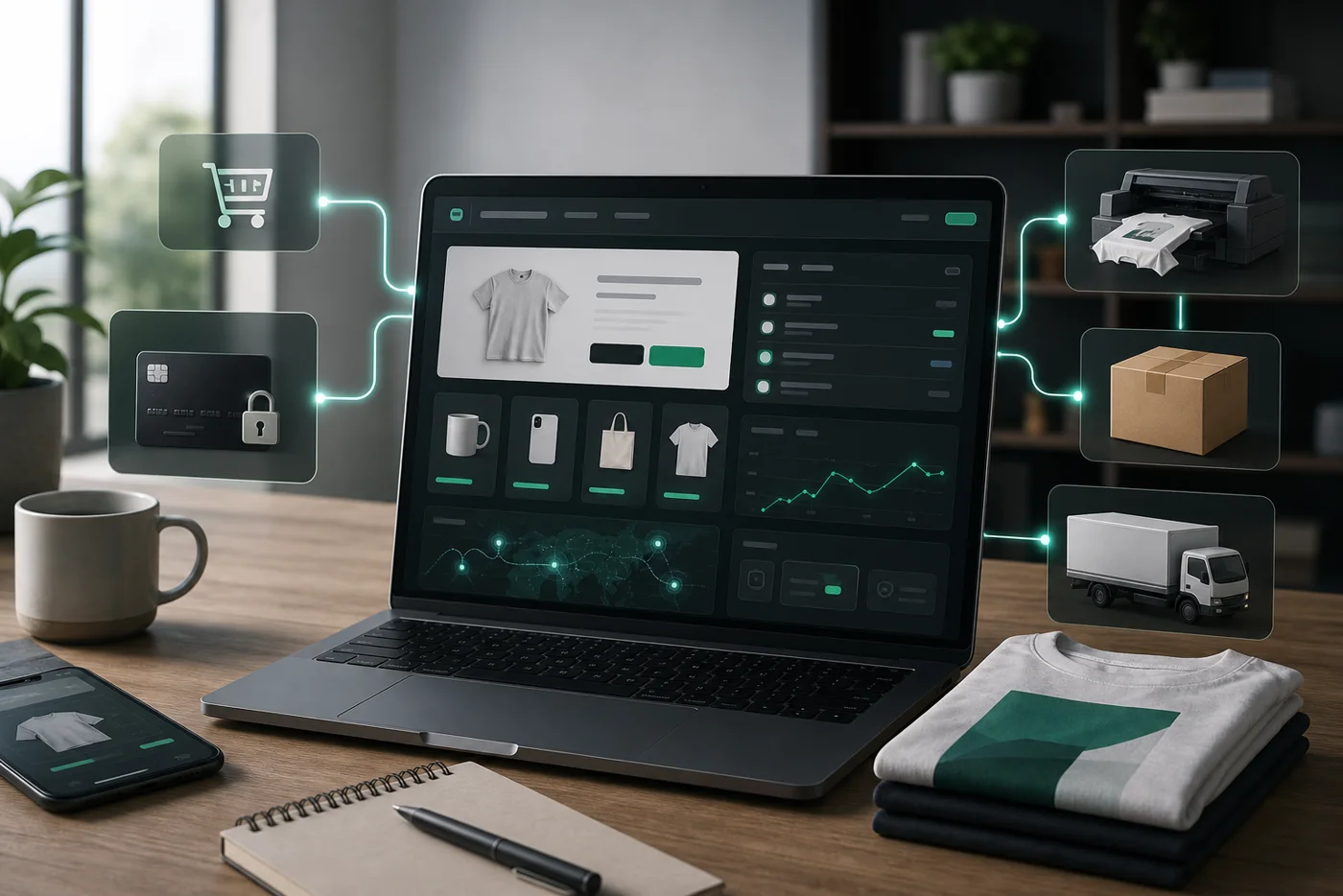
Skipping Shopify should be a decision, not a reflex. Shopify still makes sense if you want a mature ecommerce admin, a large app marketplace, common POD provider integrations, easy theme availability, and a platform many freelancers already know.
It also makes sense if you will rely heavily on Shopify-specific apps or agencies. A lot of ecommerce tooling assumes Shopify first. That ecosystem has real value.
The point is not that Shopify is bad. The point is that Shopify is not the only way to sell print on demand, and it is not automatically the best fit for sellers who care about ownership, portability, payment control, and custom POD operations.
When an Owned POD Store Makes More Sense
An owned store becomes more attractive when the business is no longer just an experiment. It may be the better route if you already have an audience, you want your own domain to carry the brand, you care about customer data and analytics, or you want checkout and fulfillment to behave in ways generic platforms do not support cleanly.
It also matters if your POD workflow is getting more complex. One provider might be best for apparel, another for wall art, another for international routing, and another for specialty products. At that point, the store is an operating system for orders, payments, routing, production status, support, and diagnostics.
If that sounds like your future, choose the platform based on the business you are trying to own in two years, not only the cheapest way to publish a product page today.
Pre-Launch Checklist for a Shopify-Free POD Store
- Who controls the domain?
- Who controls checkout?
- Where does payment land, and what fees apply?
- Which POD provider account receives each order?
- Are orders automatic, manual, or API-driven?
- Who handles customer support when an order is delayed, misprinted, or returned?
- Can you export customer, order, and product data?
- What happens if you outgrow the platform?
The last question is the one sellers often skip. A cheap launch is useful. A launch that traps a working business in the wrong system is expensive.
Want the owned-store path without stitching it together yourself?
podOS is for POD sellers who want their own domain, Stripe account, provider accounts, and Cloudflare infrastructure. Join the founding seller queue to claim your referral link and unlock launch rewards while early access is open.
Join the Founding Seller QueueFAQ
Can I use Printify without Shopify?
Yes. Printify supports multiple non-Shopify sales channels and has a Pop-Up Store option. It also offers API access for custom workflows. The right route depends on whether you want a quick hosted storefront, a marketplace connection, another ecommerce platform, or a custom owned store.
Can I use Printful without Shopify?
Yes. Printful supports non-Shopify integrations, manual orders, API workflows, and Quick Stores. Manual orders can work for early testing, but they are usually not ideal for a growing store because they add time and human-error risk. Check Printful's current Quick Stores limitations before relying on that route.
Is Etsy a good Shopify alternative for print on demand?
Etsy can be a strong marketplace for testing designs and reaching buyers who are already searching. It is not the same as an owned store. You need to follow Etsy's fees, marketplace rules, and production partner disclosure requirements for POD products.
Is WooCommerce better than Shopify for POD?
WooCommerce gives you more control and portability, but it also gives you more maintenance. Shopify is usually easier to operate as a hosted ecommerce platform. WooCommerce can be better if you want open-source flexibility and are comfortable managing hosting, plugins, updates, and troubleshooting.
What is the best ecommerce platform for print on demand?
There is no universal best platform. Marketplaces are best for discovery, quick stores are best for fast validation, site builders are best for simple branded sites, WooCommerce is best for flexible self-managed stores, and owned-store software is best for sellers who want more control over checkout, data, infrastructure, and fulfillment workflow.
Do I need my own domain for print on demand?
Not at the very beginning. You can test through a marketplace or quick store. But if you are building a long-term brand, your own domain helps you build trust, SEO value, and portability outside any single platform.